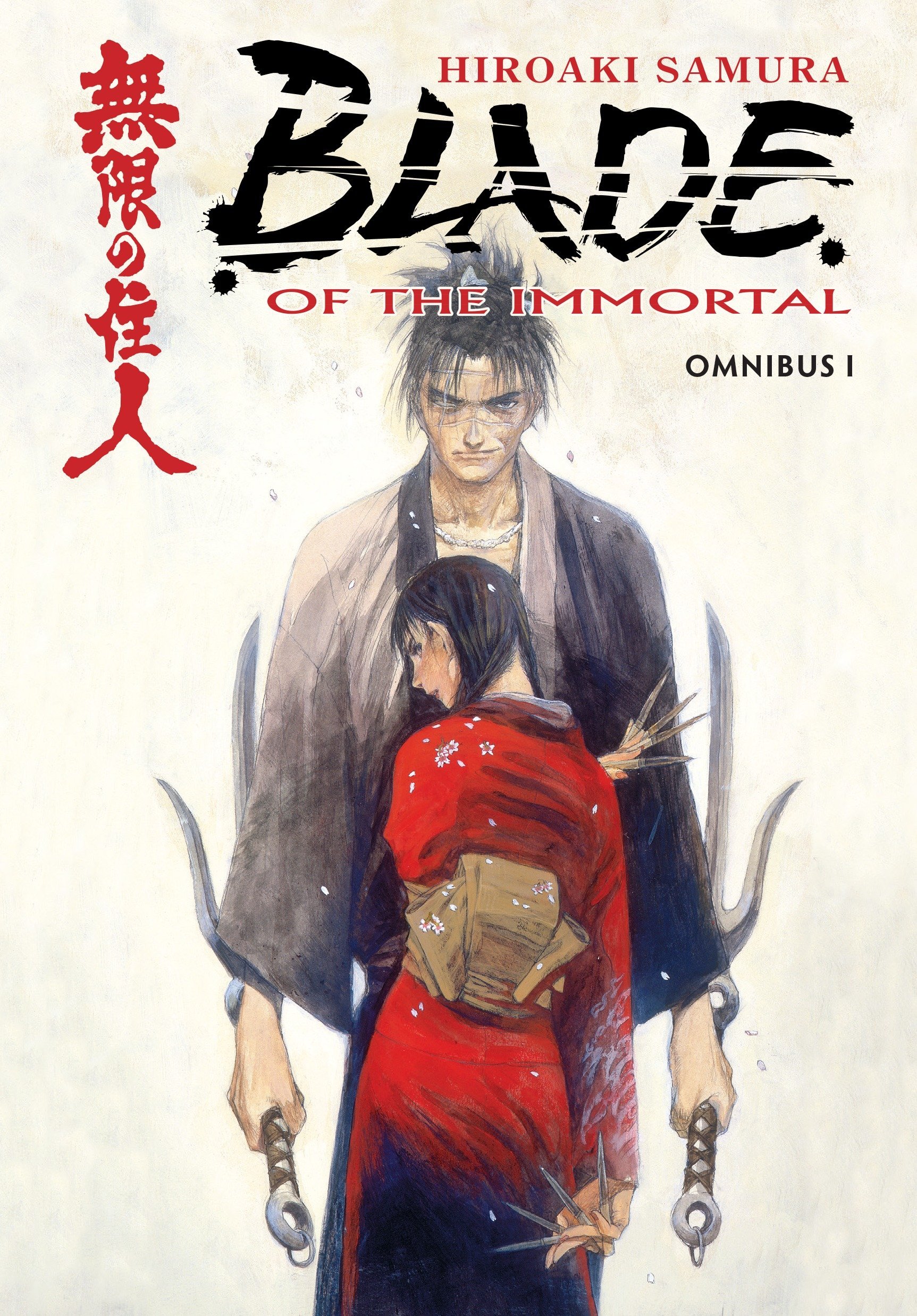
Blade of the Immortal by Hiroaki Saura, originally Mugen no Junin, published by Afternoon from Jun 1993 to December 2012. In America, it was published by Dark Horse Comics, using a cut-and-paste method instead of the mirror image method in order to make the series read left-to-right. This was done at Mr. Samura's request to preserve his artwork and to avoid flipping the manji symbol used throughout the series.
The series was made into an anime, directed by Koichi Mashimo and produced by Bee Train, released July through December 2008 and released by Media Blsters in North America in September 2009. There was also a 2017 live action film adaption directed by Takashi Miike and staring Takuya Kimura.
The manga won a 1997 Excellence Prize at the Japan Media Arts Festival and a Will Eisener Comic industry Award in 2000. It sold 5 million copies as of February 2017.
I managed to find the Dark Horse versions at a local second hand bookstore. Unfortunately, these editions commit one of my biggest bookish pet peeves: no series numbers anywhere on the books. I picked them up because of the cover art and the artwork looked amazing.
One thing to note with the art is the use of the manji symbol. For those who aren't familiar with this particular symbol, it is a Buddhist symbol that represents welfare, night, and magical practices. It is a swastika though Samura and Dark Horse both explain that this symbol is old and was perverted by the Nazis. They make a special note that there is nothing pro-Nazi or anti-Semantic in the story or how the manji is used in the story.
With that little note out of the way, I can get into the review.
Blade of the Immortal follows a swordsman named Manji who is immortal because of the bloodworms that infest his body. They mend any of his injuries after every fight. However, after a series of murders that ended with Manji killing his brother-in-law in front of his little sister. When his sister is killed in retribution for his killing another murderer, he vows to kill a thousand bad guys in order to pay for his sins.
Meanwhile, Rin is turning fourteen and waiting for her father, a doujo instructor, to get home for them to celebrate when a gang of swordsmen calling themselves the Itto-Ryu come to their doujo, kill Rin's father and rape her mother. Two years later, she finds Manji and convinces him to help her get revenge against the Itto-Ryu and especially their leader, Kagehisa Anotsu.
They travel, mostly in Edo, looking for the Itto-Ryu and encounter several different swordsmen and women. Rin tries to deal with her grief but also wants Maji to acknowledge she isn't weak. Maji fights the different swordsmen and contemplates his immortality and the fragility of life. He also meets another swordsman with the bloodworms who has lived nearly 200 years and witnessed leaders rise and fall, losing his empathy for life in the process.
There are times where Rin wavers on her revenge plot, not sure if killing so many people is the right answer. And there are times that she hints at a crush on Manji, or at least wanting him to consider her a young woman.
There is no real plot within the first four volumes other than learning about the main characters and the main conflict. By the fourth volume, we also learn a little more about Anotsu and why he is so focused on crushing all of the other doujos as well as his plan to turn his group into their own school for the shogunate. There is also another rogue group being created, called the Mugai-Ryu, who are hunting Anotsu. One of their members, a cruel murderer named Shira, finds Manji and tries to convince him to join them. Shira and Rin share a moment where Shira explains to her how he became strong in his swordsmanship-- killing people since he was sixteen-- and how she needs to view the people she kills as a way to make herself stronger. He uses the example of eating red meat-- a delicacy at the time-- and how people feel sorry for the animals being slaughtered but are still paying a lot of money to eat things like pork. His argument is that the meat becomes part of him, giving him strength and life. Something has to die in order for him to live. Unfortunately, he then emphasizes this by waiting until Rin has eaten some of the prepared meat only to reveal it was from the dog who had adopted the night before. She becomes sick and he mocks her for being weak. However, at the end of the volume, you get the feeling that she has something planned to deal with Shira.
Throughout the volumes, the artwork is stunning. Everything is stylized and the gore is done in a way that it is shocking but not overly grotesque. Most of the female characters all look the same, as well, making it tricky to keep track of some of the swordwomen and civilians that we encounter. Rin could fall into this as well if it weren't for the rings tied into her braids.
Reading through this, it reminds me of Rurouni Kenshin and Samurai X, possibly because of the historical setting and focus on the samurai. There are also a couple of words and sword techniques mentioned in Blade of the Immortal that sound familiar to Kenshin and Samurai X.
In the end, I enjoyed these first four volumes. They're interesting and stunning. This is a mature series. In the end, I'd recommend them only to people who enjoy slower, historical series or series that are more philosophical.
Comments
Post a Comment