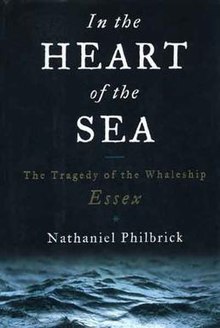
In the Heart of the Sea by Nathaniel Philbrick is the non-fiction tale of the sinking of the Essex, a whaling ship in 1820 which inspired the American classic, Moby Dick by Herman Melville. Philbrick pulls from the accounts provided by the ship's captain, first mate, and 14 year old crew member as well as the newspaper accounts of the time to create an in-depth and compelling retelling of the voyage and eventual survival at sea. Despite telling readers in the first chapter of the fates of these sailors, you are still drawn into the story and desperately wish the men luck as you read.
I typically do not read non-fiction. Far too many biographies and research projects in school has made me hesitant to pick them up. However, In the Heart of the Sea was different for me. Philbrick doesn't just tell you about the men starving in the long boats, he explains what happens to the human body in cases of extreme starvation and dehydration. He explains the sailing culture of the time, the rules of the sea, the whaling industry, and the Nantucket society at the time of the Essex. Not only did I learn about the ship itself, I also learned the significance of the whale attack-- even the leading hypothesis of why a whale attacked the ship-- and how it had such an impact of the American people as a whole.
Philbrick is also very fair with the depiction of the men. There is no "villain" or person to blame; just men trying to get by in a dying industry. Captain Pollard is depicted as a man with a gentle personality who is inexperienced with running a ship. He makes poor decisions which endangers his crew on more than one occasion. First mate Chase, on the other hand, is aggressive and acts above his position, often persuading Captain Pollard to do things against Pollard's judgement. In this way, he also endangers the crew on a few occasions. It was also Chase who first published the account of what happened aboard the Essex, careful to make himself appear more favorable throughout the account in order to protect his chances of getting another job. I believe it was that account that influenced the movie more than the book.
The movie adaptation of this book attempted to fictionalize these real events. Marketed as an adventure-drama, the movie came out in 2015 and stars Chris Hemsworth, Benjamin Walker, Cillian Murphy, Tom Holland, Ben Whishaw, and Brendan Gleeson. I will admit, 2015 me had never heard of the book and only wanted to see this movie because of Hemsworth but I am grateful I didn't see it until after I read the book.
In this adaption, we begin with Herman Melville interviewing a much older Thomas Nickerson. Nickerson had been the 14 year old who survived the Essex. As Nickerson narrates, we are taken to Owen Chase (the first mate) and a sad attempt to make his character symothetic as he's preparing to leave on another voyage, leaving his pregnant wife alone in Nantucket. He wants a position as captain but that is given to Pollard because of Nantucket's obsession with family names and history of the island. This element isn't well explained in the movie and is supposed to set up conflict between Pollard and Chase.
Upon setting sail, we see more of Chase and Pollard struggling against each other as Chase works more closely with the crew, gaining their respect, while Pollard's inexperienced decisions endagers them. Pollard attempts to shift the blame to Chase but ultimately agrees to drop the matter in the hopes they'll return to Nantucket soon after.A side story between Chase and Nickerson begins to develope that resembles a father-son relationship, but it ultimatly does nothing to the story and goes no where.
The voyage is quickly passed over and then the ship is attacked by the whale. While this was an impressive scene with some camera work done from the perspective of the whale, there were also elements of the wreck that is obviously meant to highten the adventure part of the story. Now adrift at sea, the viewers are informed of the passing of time by the growth of the men's beards and the script in the corner of the screen. This part is again quickly passed over, offering little development to the people in this situation, and even passing over the cannabilism and murder that occured, only briefely touching on it despite this being an increadably significant detail to the survival of the remaining crew, and to the sensationalism of the story at the time.
The movie finishes with a "bittersweet" ending as the few main characters return home to their families and continue on with their lives. Herman Melville gets the story that inspires Moby Dick, and the credits role.
I'm not sure if I didn't like the movie because I'd read the book and new all of the information the film chose to leave out, or if it was simply a story that was poorly adapted to film. Conflict between characters was flimsy at best, the "action" scenes were over done compared to actual events, and important elements were glossed over. Chase is made out to be the "good guy" even though there is no good and evil in this story, the symbolism of the whale is drawn from Moby Dick and not actual events, and some of the most interesting elements of the story (like why the survivors were all from Nantucket and not the main land, why the African-American men were the first ones to die and be eaten, and why the Essex had so much trouble in the first place) are not depicted or addressed at all.
Over all, I can see why this movie did not do well but the book is an incredible read that blends fact, explanation, and story telling to make an event like the sinking of the Essex accessible to any reader. Read the book an then give the movie a try.
Comments
Post a Comment