
Update 9/28/18: I am now an affiliate with Z Publishing House. I do get a
small commission from any purchases through this link (
http://www.zpublishinghouse.com?rfsn=1831564.e6264) if anyone is
interested in some anthologies of emerging writers.
Children of the Sea, or Kaiju no Kodomo in Japanese, is a 2007 five volume series written and illustrated by Daisuke Igarashi, author and artist of Witches (2004 Excellence Prize), Little Forest (2005 Ozamu Tezuka Culture Award nominee), and Saru (Manga Taisho nominee). This series is a seinen adventure manga originally published by Shogakukan and published in English by Viz Media.
For those who don't know, seinen is a manga style aimed at "young men" ranging from ages 20 to 50. This type of manga tends to focus on bigger subjects like politics, science fiction, fantasy, and relationships. Akira, Tokyo Ghoul, and Ghost in the Shell can all be considered seinen manga.
To be completely honest, I read this entire series back in the beginning of March but I had no idea how to even approach writing this review. I'd just pulled it off my library shelf at random and read one volume each day over the next five days. It took me a full day to unpack and collect my thoughts on each of these volumes; so with that in mind, I will be reviewing the whole series in this post since it would be harder to cover just one book at a time.
Children of the Sea begins as a story being told by a mother to her son about her one of her childhood summer vacations. After being kicked off her soccer team for being too aggressive, Ruka is left with nothing to do. On impulse, she decides to go to the ocean where she meets a boy named Umi. From there, she'd drawn to his world of scientists, the ocean, and strange marine phenomenon. Dispute the fact Umi and his brother Sora live at the aquarium where Ruka's father works, the adults are more interested in the global disappearance of aquarium fish than the children. As readers advance through the volumes, they realize the perceived world is not all there is. Sora and Umi were raised by dugongs and the boys are now willing experiments to a scientist named Jim.
 Volume 2 reveals Sora and Umi are not alone. There are other children raised and living in the ocean, some are thought to be spirits, others are unfortunate kids whose bodies are found after "accidents." Sora is convinced Jim isn't getting anywhere with his research and decides to go with Anglade, another unorthodox scientist who promises answers but from a different perspective. Umi becomes depressed and mute without his brother and Ruka begins to discover what the boys are.
Volume 3 starts with Ruka traumatized by Sora's disappearance but she
now hears whispers from the ocean. In the hopes of finding Sora, she
leads Umi and Anglade to the site of a meteor crash. This is also the
volume where Sora, Umi, Anglade, and Jim's back stories are explored.
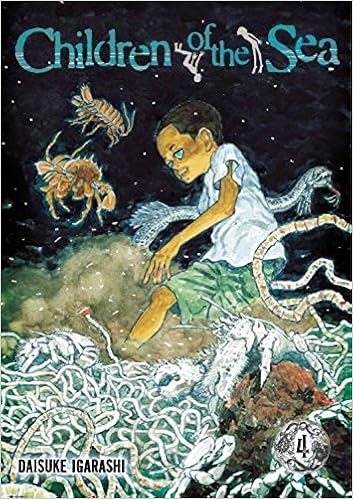 Volume 4 Jim and Ruka's mom, Kanako track down Anglade's boat but cannot find Umi and Ruka. It's revealed a past promised made by Kanako may have something to Ruka's fate, and Ruka is left to discover the meaning of the universe.
And finally volume 5. Ruka learns what part she plays in the lives of Umi and Sora as well as between the physical and spiritual realms.
 Calling this an "adventure" manga is a bit misleading. There are no shocking reveals or fast paced action. Everything is a slow build to the end. It's more of a literary manga, written to prompt thought, not entertain and thrill. This means it's a bit slower than readers might expect with side stories or "interviews" sprinkled throughout the chapters that reveal more about the ocean but add little else to the plot. That being said, nothing is wasted. The interviews expand on the readers' view of the ocean. A few characters do feel juggled because they don't play a big role until later, and even then it's not much of a purpose.
Despite not being a traditional action story, it's incredibly interesting. Adult Ruka is telling the story of young Ruka. At the same time, you're learning Sora and Umi's story, the stories of others who've encountered strange things in the ocean, and the story of the universe as young Ruka understood it. There isn't a lot of conflict beyond what is this and why is it happening.
So who are the characters? Ruka, Umi, Sora, Anglade, and Jim are the main characters. Ruka's parents do play a small part but their marital problems don't really do anything for the over-all story except possibly set up Ruka's home life as unpleasant, but we never really learn what it is about her mother that she dislikes. Is she lazy? verbally abusive? uninterested in her daughter's life or is Kanoko's behavior just a perception of Ruka's? Her relationship with Ruka is never clearly denied.
The five main characters, however, are interesting parallels with each other. All are outsiders in some sense, Ruka doesn't fit in with her teammates and people gossip about her on the streets just like Sora and Umi aren't normal kids. Anglade and Jim are both unorthodox scientists-- they actually remind me of Plato and Aristotle, one seeking truth "in the stars" and the other truth in the physical. Even Umi and Sora are an interesting parallel. Umi-- which means "sea"-- is dark and personable while Sora-- which means "sky"-- is fair and critical of others. These characters aren't completely believable since we don't get to see a wide range of their personalities but readers can forgive that since the story isn't the most realistic to begin with. Perhaps a little more time developing Ruka's history would have helped with this but we do get everyone's back story so there isn't much reason for them not to develop. Out of all those stories-- and characters-- Anglade is the most developed and most interesting. He's more open to explaining why he thinks things are happening, even if his opinions are more fantastical than Jim's. He's also impulsive like the kids but has the experience of an adult to influence him.
So what about the art style? I'm . . . not really a fan. Described as "earthy" or "photo realistic" by critics, I'd call it more "blurry." It's not a style I'm accustomed to so this may be a limited opinion. The characters aren't done with smooth lines, making them more realistic (?) while the settings are more subtle. The style looks a lot like a watercolor painting, detailed but still blurred. I will say the ocean views and animals are incredible and I love the few colored images that are sprinkled throughout the books. This lets the panels support the story. The city and beach scenes are in striking contrast to the dark and twisting ocean scenes. They're also incredibly easy to read, despite it being a dialogue heavy manga.
Igarashi's style is described as "bold", "fantastical," and "innovative" in his art and storytelling. A lot of his art and story elements are drawn from nature, folktales, spirituality, and surrealism. Everything is done with a purpose and either relays something about the characters or the universal ideas he's trying to establish. The dialogue is also used to do this, swinging from realistic and plot base to poetic and thought provoking. Overall, it's an interesting story with heavy use of themes and symbolism. It's also interesting to see the story start so strongly in the relatable world and end in an entire book with nearly no dialogue. This digression also makes it hard to read all at once. After each volume, I had to wait a day to digest what it was I had read before I could move on.
This is a very serious manga, which is also odd for me. Typically there's some kind of humor in what i read, even if it's not meant to be a comedy, but everything does flow together nicely. Even the interview interruptions build the idea of the ocean being something greater than what we understand it to be and establishes the possibility of deities or spiritual creatures. As I've said, symbols and themes are huge in this story. The ocean, the universe, stars, spirits, life, birth, and death, sky and water, human and god, modern and traditional, science and spirituality, there's a lot to unpack and I've no idea where to start or if i understood it correctly but it does seem to be connected to a continue existence or cycle between life and death and the truths about the universe.
Out of everything and everyone in this series, Anglade is my favorite and his experience while diving in the Antarctic is one of my favorite parts. This is where the reader learns so much about the two scientists and the events that are occurring to Ruka. It's also a good balance between the real an surreal. A close second comes from an interview of the man who encountered a "spirit" who shifted between a boy and "the king whale." The images are fascinating and terrifying all at the same time.
I didn't really like the book end story of adult Ruka talking with her kid. It felt so wrong after the surreal wtf experience of the last book. At no point was I sure where Ruka was or what was real and what wasn't. This was quickly followed by no dialogue or explanation so readers are left to interpret her experience on their own. It was a lot to take in and not have some guidance with afterward.
I don't mind non-linear stories and the interruptions do have a purpose but I needed to know when things were shifting. There are no time markers or narrator markers that indicate how much time has passed or if the story is no longer the main plot.
In conclusion, Children of the Sea is beautiful and is meant to be read, re-read, and digested. If anyone questions whether or not manga can be literature, point to this series. It has all the markings of literary fiction that could be studied in a college setting. This is not for beginners! Unless the reader prefers literary fiction, this is better for someone already interested in manga and wants something with a little more meat than the usual shoujo/shounen. I do recommend it but it's not for everyone. It'd also be great for a school project but not something to read over and over for the pure pleasure of it.
I read all five volumes and I would be interested in looking at Igarashi's other works sometime in the future. It's not a style I'm used to but I want to see what his "shorter" works are like in comparison to this.
Comments
Post a Comment