Update 9/28/18: I am now an affiliate with Z Publishing House. I do get a
small commission from any purchases through this link (
http://www.zpublishinghouse.com?rfsn=1831564.e6264) if anyone is
interested in some anthologies of emerging writers.
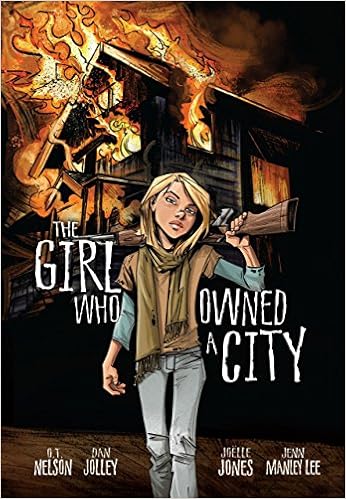
The Girl Who Owned A City was originally a novel written by O. T. Nelson in 1975 and was later adapted into a graphic novel by Dan Jolley and published by Graphic Universe. While O. T. Nelson never went on to write another book, Jolley had worked on DC Comics' Firestorm and Graphic Universe's Twisted Journeys. The artist-- Joelle Jones-- is also known for Lady Killer.
A strange disease has swept through the country, killing everyone over the age of 12 within a month. The protagonist, Lisa Nelson, is the first one on her block to think of using her father's car to raid a farm for supplies. As she successfully gathers supplies, the other block children become jealous and resort to stealing from her and her little brother. Gangs are starting to form in the area and threatening those who refuse to join or give up their supplies. Lisa finally offers supplies to the other kids in exchange for their cooperation in turning their street into a militia. This fails so Lisa plans a fortified city within the high school. This new city is successful until one of the gangs attacks and Lisa is shot. She survives thanks to a few friends and plans to take back her city. While she's planning, she learns about other dictators and warlords, including the Chicago King, who are growing in numbers and threaten the safety of Lisa's community. She finally takes back her city and the kids celebrate.
I was interested in the concept and picked this up at my library hoping for a fun read and possibly a new series. This whole story fell flat on its face. *Spoilers to follow*
Everything in this story comes off as urgent so facts are learned quickly, mostly through inner dialogue while the images show the kids organizing and preparing for the inevitable. This gives the impression there's a lot to get through in just 126 pages and it builds a lot towards the end. There are a few points, like the attack on the City and when Lisa sneaks back in, where you hold your breath but these are few and very brief. Everything feels rushed in order to get to something bigger at the end but that something never comes. Lisa is bossy and doesn't let anyone else make suggestions or take credit for their work, yet none of the other kids have shown incentive to solve their own problems and all look to her instead. She does reveal some stress about this but never to another character and instead points out their lack of effort and thus claims all right to everything they've built because she was the one planning and organizing it. This self-righteous defensiveness and stubborn dictatorship makes her unlikable and I ended up despising her throughout the story. She claims the moral high ground but in comparison, she's not all that different from the other gang leaders and warlords which could be interesting if she had to directly face this fact, either between herself and Tom Logan or herself and the Chicago King but this never happens and the setup is missed. Logan is never all that threatening, despite his conquering the city, and the Chicago King is mentioned of having an army over a thousand strong but he's never referenced again and never appears so there is no real enemy here.
All of the characters come across as flat and useless. Craig is the only one I could empathize with. He's smart and gentle spirited, suggesting the kids start their own farm in order to grow their own food instead of raiding homes, stores, and warehouses for supplies. Lisa shoots down these ideas as not practical for the immediate future, also claiming a farm would be too easy a target for gangs, leaving Craig with nothing.
Out of the entire cast, Craig is the only one who doesn't feel cookie-cutter. He's looking for a way back to a normal life without threats and violence, he's the oldest one alive and has the most life experience before the disease. He's also the most human. In private, he tells Lisa he's worried about what will happen when he reaches twelve years old-- will he survive or will the disease turn him to dust like all the other adults?-- and he's willing to show anger and argue against Lisa's treatment of the other "leaders" in the city. We never see Lisa do this beyond an inner dialogue questioning her ability to lead but she never openly asks for help or admits she's wrong. Instead of learning how to encourage the kids to become independent or teaching them how to survive on their own, Lisa bribes and bullies them into building her city and her army, following her lead in exchange for food and protection-- just like Tom and his gang. Craig is the only one who actually leaves Lisa and her city in order to find something better. And Tom proves incapable of running the city like Lisa.
Like any other post-apocalypse characters, you have the "bad-ass girl" character, at least one macho, conqueror guy, and someone else looking for the peaceful life. Everyone is flat and nearly identical. We as the reader are supposed to root for Lisa since she's the only one who "thinks" and is capable of leading the others but the actions depicted in the story don't do anything to endear her to me.
Now this is a graphic novel adaptation so how are the visuals? Dark and harsh lines give everything a gritty appearance, and the colors tend towards dark and dull. This makes sense for a gritty apocalypse story. The panels are pretty standard and don't draw attention to themselves, letting you focus on the story.
My problem with this is while it fits the idea of an apocalypse, it doesn't fit the squeaky-clean end of the world story that's being told. Imagine that super conservative soccer mom who won't let her kids watch or read anything not made by a Christian author because anything else is too "dark" or "worldly" and will corrupt the mind. Yes Lisa's shot but she survives and is easily treated. Yes Tom's face has been burned by hot oil but we never see this occur and the image isn't all that frightening. But compared to other stories in this genre, there isn't much grittiness or serious elements Lisa and the others have to deal with-- at least none that we're shown. Even the disease that kills the adults is clean; everyone just turns to dust and is blown away by the wind.
I blame the writing for most of the problems. The premise is interesting and the beginning sets up for something bigger to happen but it falls flat in the payoff. Either 126 pages wasn't enough to work with or the writers weren't willing to take it to the conclusion that was being suggested. Dialogue is decent, if a little too archaic in Lisa's inner monologue, but that's the only way information can be delivered. The overall script is simple; decent but not believable, with no payoff in the end. A few possible reasons for this could be a) key elements and character development was lost in adaption from novel to graphic novel, b) this is supposed to be some kind of satire or social commentary but it is ignored or not conveyed well, or c) O. T. Nelson's original novel wasn't all that good to begin with and this is a faithful adaption.
On a small side note, I did a google search on the original novel. O. T. Nelson published it in order to pay the employees of his small house-painting company. It follows the plot exactly, is 181 pages long, and there were originally going to be sequels but nothing else was ever published. The original cover also compares this to Lord of the Flies. No where could I find an article of how it was received at the time, but the reviews on Goodreads range from "I read this in elementary/jr. high and thought it was the best book ever" to "this is the worst thing ever written on the face of the earth" so I'm comforted in knowing I'm not alone in my opinion of this story (novel or graphic novel).
So final commentary. Lisa never grows as a character and has little to no compassion for the others beyond getting them to follow her plans so they'll survive. Craig is the most mature and is more interested in being self-sufficient but this mentality never affects Lisa or the other children so the matter is dropped as soon as he leaves. And Tom serves no other purpose than to be the "bad guy" that Lisa has to overcome in the end-- which is done through shamming him into acknowledging he can't run the city because he's not smart enough to do so.
The best part is when Craig calls out Lisa for not treating the others well. He's the most human of the characters and Lisa is a demanding and selfish character who we're supposed to empathize with. The worst part is the ending. The Chicago King is introduced as being a bigger problem than Tom but we never see the "threat" of this King and the setup never comes to fruition. Overall, the story just needs more. Logan could be a decent beginning to change. Perhaps he could come back as a potential ally and Lisa would be forced to ask for help, admit she was wrong, or even deal with what she's become.
The Girl Who Owned A City has an interesting premise; it's a cleaned-up version of an apocalypse for younger readers who won't realize the characters are unbelievable, the plot doesn't make a ton of sense, and it never reaches a satisfactory conclusion. It's not one I would recommend. Most people seem to have read the original in jr. high but there are so many better stories that they could be reading. Maybe it had better development in the novel but based on what I've found, it doesn't sound too promising. Anyone who's just starting to get into apocalypse stories might pick this up but it's not the best example of the genre. I have no intention of reading the novel any time soon.
Comments
Post a Comment