Update
9/28/18: I am now an affiliate with Z Publishing House. I do receive a
small commission for items purchased through this link
(http://www.zpublishinghouse.com?rfsn=1831564.e6264) if anyone is
interested in anthologies of emerging writers.
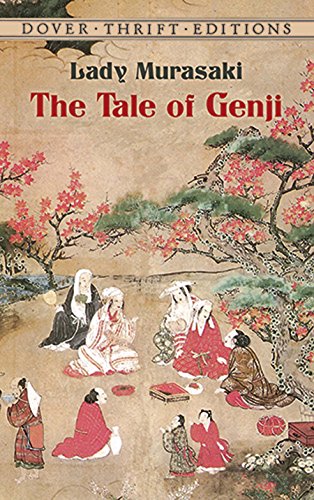
The Tale of Genji was written by Murasaki Shikibu in the
early 11th century. This is a classical Japanese work and is
considered the first ever extended prose in history. Originally written for the
noble ladies of the Japanese court, I read the version (translated into
English) published by Tuttle Publishing. My version had 17 chapters though the original is said to
have 32 to 46 chapters, though there is some discussion about how likely the
later chapters were written by the original author.
Considered the first “modern” romance, the Tale of Genji was
likely written and recited chapter by chapter in an episodic method. There is
no overarching plot per say, but the author took great care to keep the
internal consistency. We follow the life of Genji, the second son of the
emperor. Because his mother was a consort and not the empress, Genji is unable
to inherit the throne—the empress in particular was jealous of the consort—so
he is given a station as an imperial officer.
We follow Genji’s love life as he grows up. From his
betrothal to a high ranking lady to his affairs, word games with his crushes,
and even the abduction of a child in order to raise her as his own daughter.
The first real indicator of the “plot” occurs in chapter two when Genji and his
male friends are discussing love and what makes a “good woman.” Each of his
friends has a different opinion and Genji finally decides he’s going to test
out each of their suggestions to find which one is correct. The rest of the
book follows these exploits as he flirts and courts various young women. Some
become just friends, others become lovers; he does have a son by one of these
women—the wife of his half-brother the emperor heir-- and he does adopt the
daughter of another crush, despite the fact her biological father is still
living and has no knowledge of Genji’s involvement, in order to raise her as
his “ideal woman.”
Eventually, one of Genji’s relationships gets him into
trouble with the empress and he is exiled. He is banished from the court to a
small village by the coast. This scandal is overthrown when the ghost of the
late emperor appears and sends Genji home.
Since my version was shortened (according to the publisher’s
note it was done to remove repeating passages and events in an attempt to
streamline the plot) the ending felt very abrupt. Genji returns home, his half
brother is glad to see him, and he returns to his life as usual . . . and then
it ends. I would need to find a complete version in order to see if there was
more to the story—though some scholars believe chapters 34 and onward were
written by a different author.
I had trouble getting through this book. I understand this
book reveals a lot about the court of ancient Japan. I understand it was a male-centric society. When the plot was revealed, I was furious! He is
married—granted it was arranged by his father for political standing and not
love—but he goes through these women without really considering what he’s doing
to their emotions. Some of them reject him and he continues to pursue them,
while others are to shy to protest and let him do whatever he likes. It’s
infuriating to me.
There was also the lack of real development and conflict
that made it difficult to read. When the scandal of his affairs does surface
and his brother banishes him—though he admits he’s impressed by Genji’s
exploits—there starts to be some kind of gripping conflict. Scandal, political
rivals, bad blood resurfacing between the empress-mother and Genji: I was
actually excited to see something besides poems with double meanings and gifts
between Geni and his lovers. But then the ghost of the emperor appears and
Genji is allowed to go home. This Deus ex Machina killed the last of my
patience with this book. Thankfully it ended soon after, but again it was a
sudden stop.
Again, I get that this is an old book, written by a women in
a strict patriarchal and class-based society, dealing with a “safe” topic for
her at the time. I also know there’s probably some problems with the
translation—11th century Japanese to modern Japanese to English—and
I may have a more abridged version, but this was not an easy read for me to get
through.
Tale of Genji is a Japanese treasure. It’s hugely important
for the history of books and novels as we know them. It reveals a lot about the
court life of ancient Japan. And it’s important to know that the first work of
extended fiction was written by a woman. I am happy that I read it just for
those reasons, but I am not likely to read it again—at least not for a long
time.
If you’re looking for intricate plot or modern romance, look
elsewhere. This book is important. It should be read. I don’t see it being
anyone’s favorite unless it’s for a college class in a specific major. To be
honest, I think I would get more out of this if I had read it in a college
class. If you enjoy historically significant books, this is something you might
find interesting.
Comments
Post a Comment